If you’re stepping into the world of electronics, knowing the essential components is key. Resistors, capacitors, and microcontrollers form the backbone of many projects. Each component plays a unique role, influencing how your circuits behave and interact. Understanding their functions can set you on the path to innovation. So, what do you need to know about these crucial elements? Let’s break them down one by one.
Resistors: The Basics of Resistance
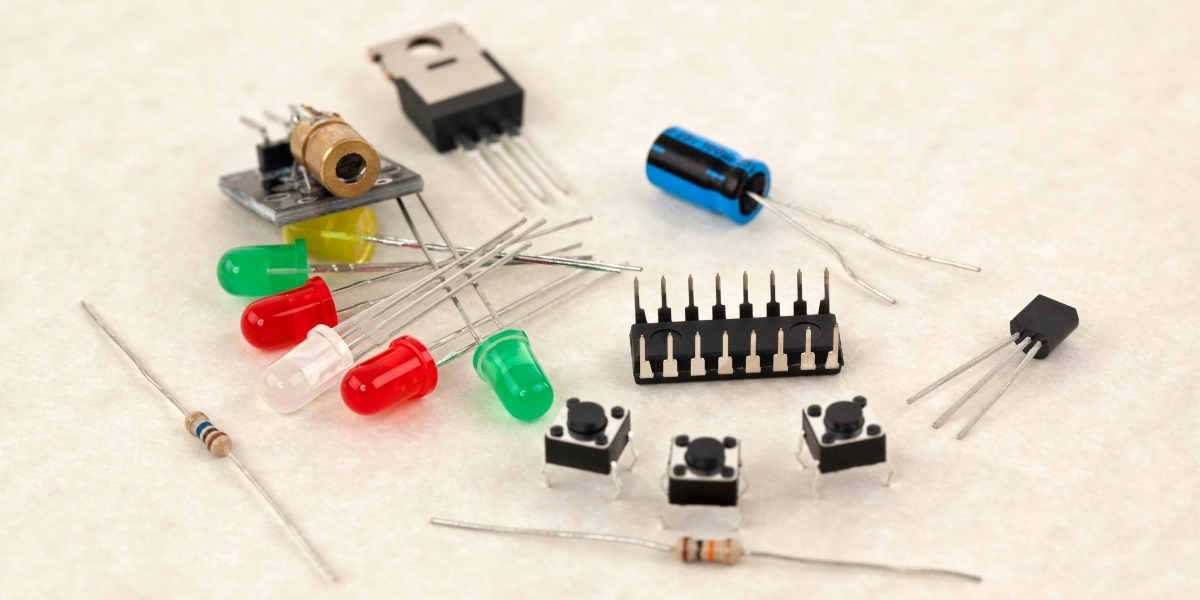
When you dive into electronics, understanding resistors is essential because they control the flow of electricity in a circuit. Resistors limit current and protect sensitive components from damage. They’re measured in ohms, and you’ll often see color codes on them to indicate their resistance value.
Knowing how to read these codes is crucial for selecting the right resistor for your project. You’ll encounter fixed resistors, which have a set resistance, and variable resistors, like potentiometers, which allow you to adjust resistance.
Capacitors: Storing and Releasing Energy
Resistors manage the flow of electricity, but capacitors take on a different role by storing and releasing electrical energy. You’ll find capacitors in various applications, like smoothing out voltage fluctuations in power supplies or timing circuits in oscillators.
These components consist of two conductive plates separated by an insulating material, known as a dielectric. When you apply voltage, the capacitor charges up, storing energy in the electric field between the plates.
When it discharges, it releases that energy back into the circuit. Understanding how capacitors work is crucial for building effective circuits.
They come in different values and types, so knowing which one to choose can significantly affect your project’s performance. Experiment with them to see their impact firsthand!
Microcontrollers: The Brain of Your Projects
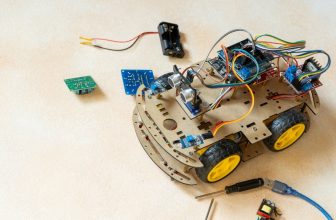
Microcontrollers serve as the brains of your electronics projects, enabling you to control devices and process information efficiently. These compact integrated circuits can execute programmed instructions, making them ideal for tasks ranging from simple to complex.
You can find popular microcontrollers like Arduino and Raspberry Pi, which provide user-friendly platforms for beginners. By connecting sensors, displays, and actuators, you can create interactive systems that respond to real-world inputs.
You’ll appreciate how easily you can program these devices, often using languages like C or Python. With a microcontroller, your creativity can flourish as you build projects ranging from automated lights to robotics.
Dive in and see how these powerful tools can bring your ideas to life!
Conclusion
In conclusion, mastering the essentials like resistors, capacitors, and microcontrollers sets you on the path to becoming a confident electronics enthusiast. Resistors help you control current, capacitors store energy for stabilization, and microcontrollers act as the brains behind your creations. By understanding these components, you’re not just learning; you’re unlocking the potential to innovate and solve real-world problems. So, dive in, experiment, and let your creativity spark amazing electronic projects!
Trending Products
eSUN PLA+ Filament 1.75mm, 3D Printer Filament PLA Plus, Dimensional Accuracy +/- 0.03mm, 1KG Spool (2.2 LBS) 3D Printing Filament for 3D Printers, Bone White
TP-Link AX1800 WiFi 6 Router (Archer AX21 V5)

Waveshare RS232/485/422 to RJ45 Ethernet Module, TCP/IP to Serial, with POE Function, Bi-Directional Transparent Transmission, Suitable for Data Acquisition, Intelligent Instrument Monitoring, etc

CORSAIR RM1000x ATX 3.1 PCIe 5.1 1000W Power Supply – Black